 (208) 991-3502
 Meridian, ID






 January 13, 2026
Jobsite security cameras only work if they stay online. This guide explains power and connectivity options for construction site cameras and how Treasure Valley builders choose reliable setups.
Even the best security cameras are useless if they don’t stay powered and connected. On an active construction site, this is one of the most overlooked—and most important—parts of jobsite security planning.
Builders often focus on camera placement and coverage first. But in the field, power and connectivity determine whether a security system actually works day after day.
For Treasure Valley builders and contractors, understanding how jobsite cameras stay online helps avoid systems that look good on paper but fail when conditions get tough.
This guide breaks down the real-world power and connectivity options used on jobsites, along with their strengths, limitations, and best use cases.
Why Power and Connectivity Are the Weak Points on Jobsites
Unlike finished buildings, construction sites are temporary, exposed, and constantly changing.
Permanent electrical service may not be available. Internet connections may not exist at all. Power sources move as phases change. Weather and dust create additional challenges.
Security systems designed for homes or offices often fail in these environments because they assume stable infrastructure. Jobsite security cameras must be designed to operate independently and reliably, even when conditions are far from ideal.
Temporary Power Connections on Construction Sites
Some jobsites have access to temporary electrical service during certain phases of construction.
When available, temporary power can be a reliable option for jobsite security cameras. It provides consistent operation without battery limitations and supports higher-performance equipment.
However, temporary power is not always stable. Power may be shut off, moved, or repurposed as construction progresses. Cameras tied too tightly to temporary power without flexibility risk going offline unexpectedly.
For this reason, power planning must account for how long a given power source will remain available.
Solar-Powered Jobsite Security Cameras
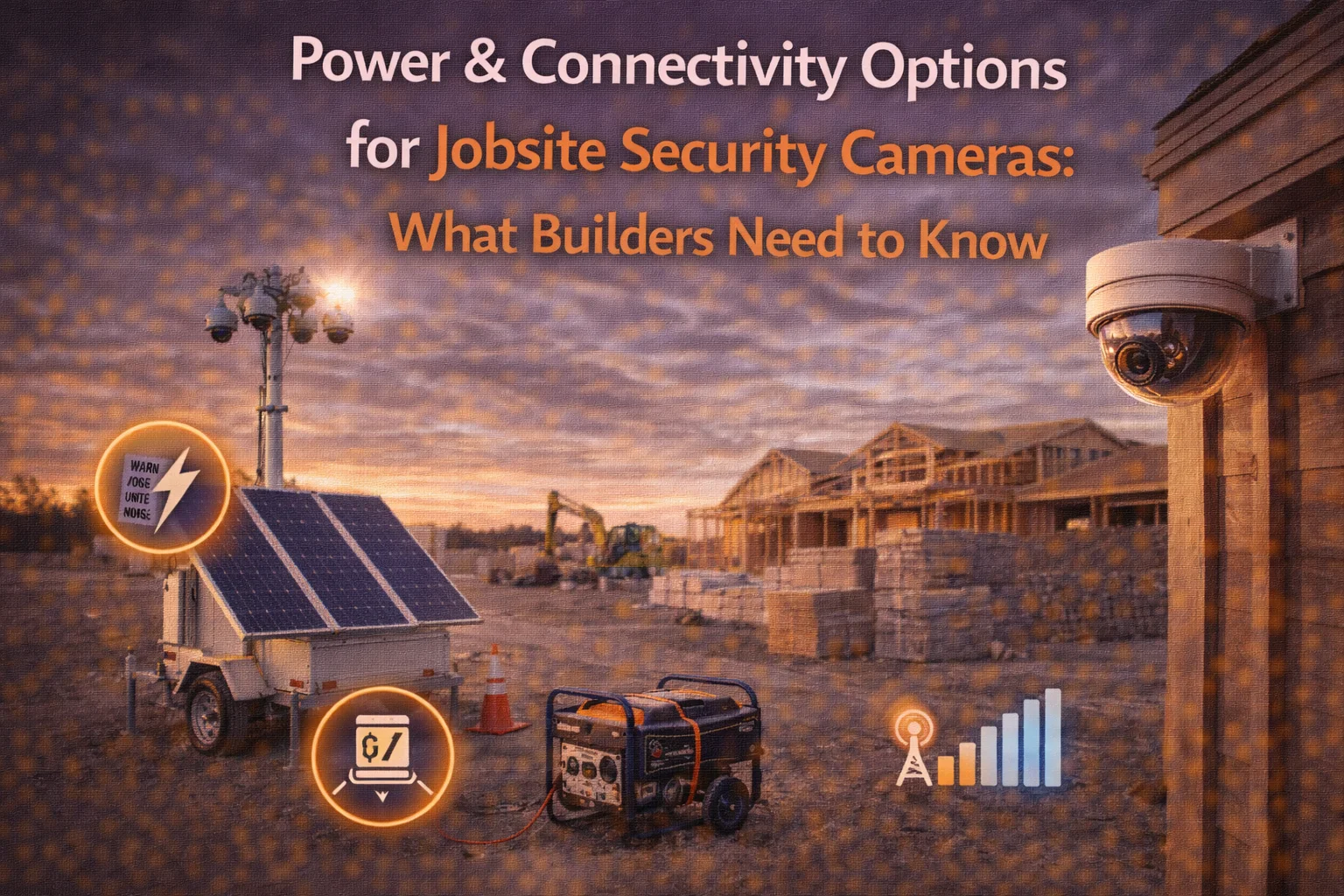
Solar-assisted security systems are one of the most common solutions used on construction sites—especially in areas without permanent power.
These systems typically combine:
Solar panels
Battery storage
Energy-efficient cameras
Cellular connectivity
Solar-powered camera trailers and pole-mounted systems are designed specifically for temporary environments. They can be deployed quickly, relocated as needed, and operate independently of site power.
In the Treasure Valley, solar systems perform well when designed properly. However, they must be sized correctly to account for seasonal daylight changes, winter weather, and camera load.
Poorly designed solar systems often fail not because solar doesn’t work—but because the system wasn’t matched to real jobsite conditions.
Generator-Based Power: When and Why It’s Used
Generators are sometimes used to power jobsite security cameras, particularly on large or remote projects.
While generators can provide ample power, they come with tradeoffs:
Fuel management
Noise
Maintenance
Risk of shutdown if neglected
Generators are usually best used as short-term or supplemental power, rather than a long-term security solution. Many builders prefer solar or temporary electrical connections when possible, due to lower ongoing management.
Cellular Connectivity: The Backbone of Jobsite Security
Most jobsite security cameras rely on cellular connectivity, not traditional internet service.
Cellular connections allow cameras to:
Operate without wired internet
Transmit footage remotely
Send alerts in real time
Remain independent of site infrastructure
This is especially important on early-stage construction sites where no broadband service exists.
Cellular systems must be planned carefully. Signal strength, carrier coverage, and data usage all affect reliability. Inconsistent connectivity can undermine even the best camera hardware.
This is why many builders explore professionally designed solutions through providers like
👉 https://treasurevalleysolutions.com/services/
who account for connectivity realities upfront.
Wired Internet: Rare but Valuable When Available
In later construction phases, some sites gain access to wired internet connections.
When available, wired internet can support higher-resolution video, faster access, and expanded monitoring features. However, it’s rarely available early in construction and may only be temporary.
Wired connections work best when security systems are transitioning from temporary jobsite use to permanent building operations.
Redundancy Matters More Than Raw Power
One of the biggest lessons builders learn is that redundancy matters more than raw capability.
A system with backup power, battery storage, and failover connectivity will outperform a more powerful system that fails when a single component goes down.
Reliable jobsite security systems are designed to:
Handle power interruptions
Maintain connectivity during disruptions
Recover automatically without manual resets
This resilience is what separates professional jobsite security from consumer-grade solutions.
Planning Power and Connectivity as a System
Power and connectivity should never be treated as afterthoughts.
Professional planning ensures:
Power sources match project duration
Connectivity is reliable at the site location
Systems adapt as the jobsite evolves
Cameras remain online during critical hours
Builders who plan these elements intentionally experience far fewer failures—and far fewer surprises.
This approach aligns with broader jobsite planning strategies similar to those discussed within
👉 https://treasurevalleysolutions.com/solutions/homeowner-solutions/
(adapted here for construction environments).
Frequently Asked Questions
Are solar-powered jobsite cameras reliable?
Yes, when designed correctly and sized for seasonal conditions.
Do jobsite cameras need internet?
They need connectivity, but not necessarily wired internet. Cellular is most common.
What happens during power outages?
Well-designed systems use battery backups to stay online.
Is generator power a good long-term solution?
Usually no. Generators require active management and are best used short-term.
Does professional planning really matter?
Yes. Most jobsite camera failures are caused by power or connectivity issues, not bad cameras.
Reliability Is the Real Measure of Jobsite Security
On construction sites, security systems don’t fail dramatically—they fail quietly. Cameras go offline. Footage stops recording. Alerts never arrive.
For Treasure Valley builders, understanding power and connectivity options is the difference between a system that exists and a system that actually protects the jobsite.
When security cameras are powered correctly, connected reliably, and planned for real-world conditions, they become a dependable part of the jobsite—working day and night without constant attention.
And that’s exactly what jobsite security should do.